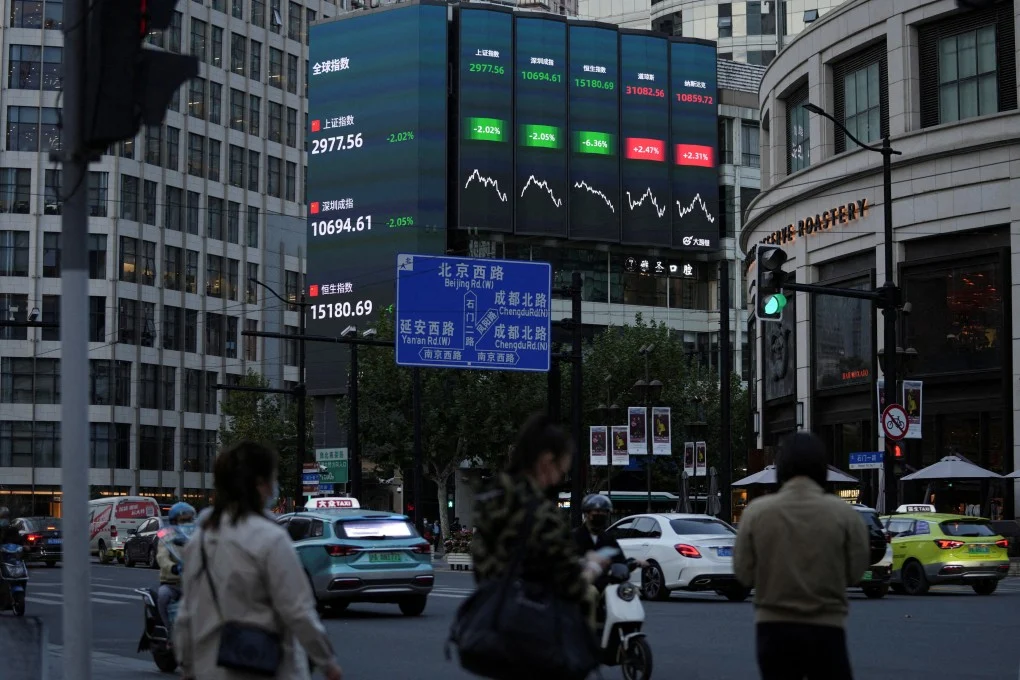
Hong Kong stocks declined on Thursday as oil prices surged back above $100 per barrel amid escalating tensions in the Middle East. Investors reacted cautiously as uncertainty surrounding the conflict between the United States, Israel, and Iran weighed on global financial markets.
The drop highlights how geopolitical risks continue to influence global asset prices. Rising energy costs and fears of supply disruptions have pushed investors toward safer positions while triggering sell-offs in several stock markets across Asia.
Hong Kong stocks decline amid oil price surge
Hong Kong stocks closed lower as investors monitored developments in the Middle East conflict. The Hang Seng Index dropped 0.7 percent to finish at 25,716.76.
The Hang Seng Tech Index also declined by 0.5 percent, reflecting weakness in major technology shares. On mainland China markets, the CSI 300 Index slipped 0.4 percent while the Shanghai Composite Index fell 0.1 percent.
Market analysts say the decline reflects growing uncertainty around the potential escalation and duration of the conflict involving Iran.
Ray Sharma-Ong, deputy global head of multi-asset bespoke solutions at Aberdeen Investments, said markets are reacting to worst-case scenarios.
He explained that investors are currently pricing low-probability risks linked to the war, which has triggered broad selling across global markets.
Oil prices jump as Middle East tensions intensify
Oil prices rose sharply after attacks on shipping vessels near key Middle East routes heightened fears of supply disruptions.
Brent crude jumped as much as 10.5 percent to $101.6 per barrel before easing slightly to about $96.3. Meanwhile, West Texas Intermediate crude climbed to around $91 per barrel.
The surge followed reports that Iraq had closed several oil ports after two tankers were attacked. The incident overshadowed efforts by Western nations to release emergency oil supplies.
The International Energy Agency earlier announced that member countries would release 400 million barrels of oil from strategic reserves. The United States also revealed plans to release 172 million barrels to help stabilize energy markets.
However, continued attacks on vessels near the Strait of Hormuz have kept markets on edge. The strategic waterway handles roughly 20 percent of global oil shipments, making it one of the most critical energy routes in the world.
Investors react cautiously to geopolitical risks
Analysts say current market behaviour mirrors previous geopolitical crises where investors quickly reduce risk exposure.
Historical data from past U.S. military operations in the Middle East suggests markets often react sharply at first before stabilizing once uncertainty fades.
Sharma-Ong noted that risk assets tend to overshoot to the downside during such periods as investors attempt to price potential worst-case outcomes.
Despite the volatility, some economists believe the energy price surge could be temporary.
Oil prices may fall within months
Swiss private bank Lombard Odier said the conflict may not last long and expects oil prices to eventually return to previous levels.
According to the bank, Brent crude could fall back to between $60 and $70 per barrel within six months if geopolitical tensions ease.
Such a drop would likely reduce pressure on global stock markets and inflation expectations.
Chinese companies lead declines in Hong Kong stocks
Several Chinese companies led the losses in Hong Kong trading.
CSPC Pharmaceutical Group dropped 4.5 percent to close at HK$8.65. Beverage giant Nongfu Spring also fell 4.4 percent to HK$43.40.
Mining company CMOC Group declined 3.9 percent to HK$19.80.
Some companies managed to limit the broader market losses. JD Logistics rose 4.2 percent to HK$14.20.
China Hongqiao Group gained 4 percent to HK$40.04 while energy producer CNOOC climbed 3.7 percent to HK$29.10.
Asia-Pacific markets also weaken
Stock markets across the Asia-Pacific region also retreated as oil prices climbed.
Japan’s Nikkei 225 index fell 1 percent while South Korea’s Kospi dropped 0.5 percent. Australia’s S&P/ASX 200 declined 1.3 percent.
The broad regional decline shows how global energy shocks can quickly spread across financial markets.
As long as oil prices remain volatile, investors are likely to remain cautious, with Hong Kong stocks continuing to react to developments in the Middle East conflict.