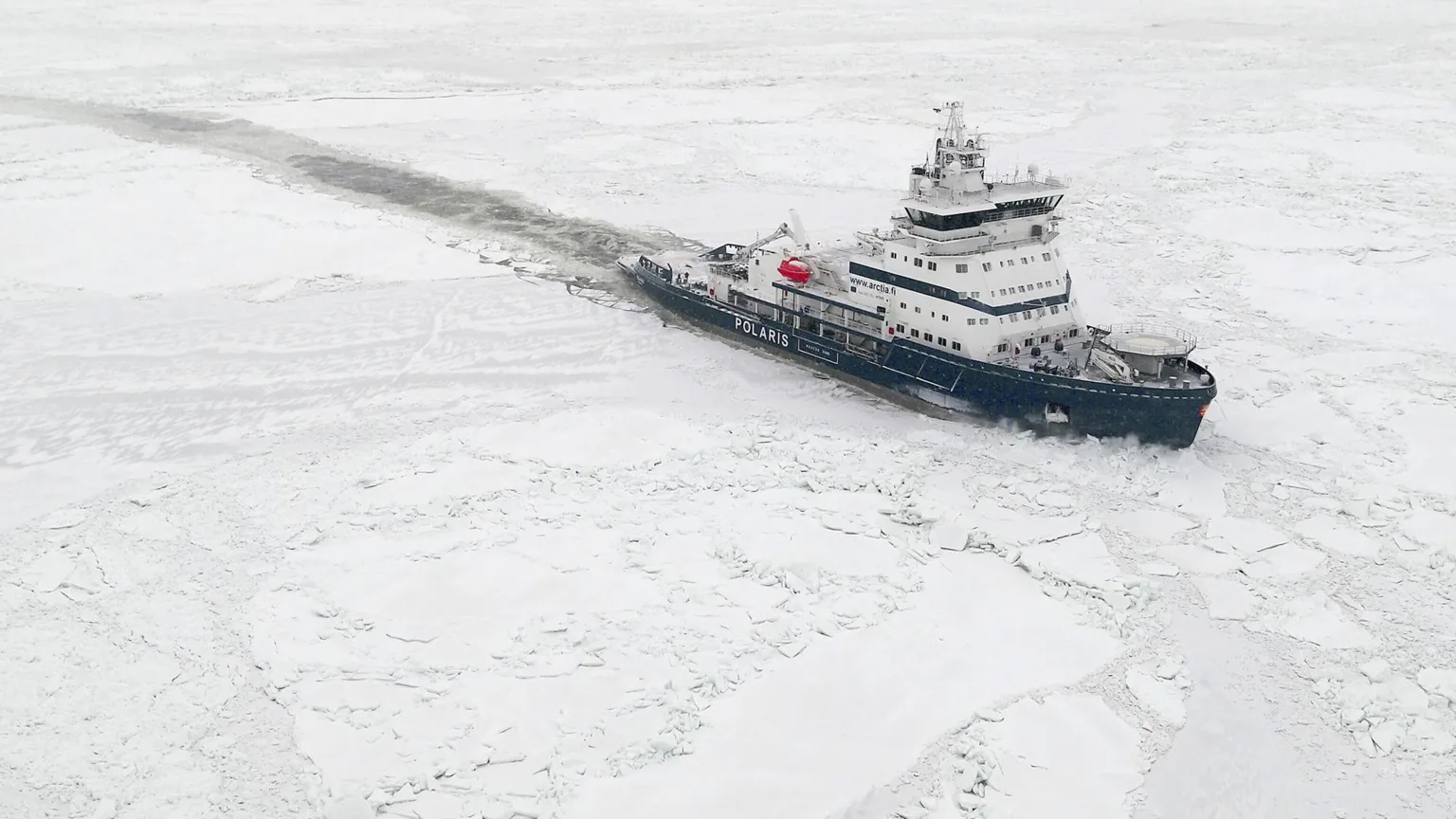
US icebreakers Finland has become a defining phrase in Washington’s evolving Arctic strategy as the United States turns to Finnish expertise to strengthen its presence in polar waters. As President Donald Trump pushes a broader focus on the Arctic, including renewed rhetoric over Greenland, the US has moved to acquire advanced icebreakers from the world’s leading specialist in ice-capable ships.
Although the US operates some of the world’s most powerful naval assets, its ability to project power in ice-covered seas remains limited. For that reason, officials have opted to work with Finland, a country whose economy and geography have made icebreaking a national necessity for more than a century.
US icebreakers Finland partnership explained
The decision to source US icebreakers Finland reflects a practical calculation rather than symbolism. Finnish companies have designed around 80 percent of the world’s active icebreakers, while shipyards in Finland have built about 60 percent of them. This dominance has grown from experience, not theory.
Finland relies on icebreakers to keep all its ports open during winter. Nearly all goods entering the country arrive by sea, and harsh conditions mean icebreaking is essential. As a result, Finnish designers, engineers, and operators have refined icebreaker technology through constant real-world use.
Why Finland leads global icebreaker design
At facilities in Helsinki, scale models of next-generation icebreakers undergo testing in frozen simulation tanks. Engineers study hull shape, propulsion, and structural strength to ensure vessels can break thick ice by bending it downward rather than slicing through it.
This design philosophy sets Finnish icebreakers apart. According to industry experts, success depends on balancing power with durability. Engines must deliver enough force to push through solid ice, while hulls must withstand repeated stress in extreme conditions. Finland’s ability to perfect this balance explains why the US icebreakers Finland deal emerged.
Strategic reasons behind US demand
Beyond engineering, geopolitical concerns have accelerated the US decision. Climate change has made Arctic waters more navigable, opening new shipping routes between Europe and Asia. These routes run above Russia or through waters near Alaska, Canada, and Greenland.
At the same time, oil and gas resources beneath the Arctic have become more accessible. Increased activity has raised concerns in Washington about security, surveillance, and influence in the region. Therefore, expanding the icebreaker fleet has become a strategic priority.
Read Also
Musk AI chatbot Grok
Early tax submissions
Doing business in Uganda
Uganda private sector outlook
US icebreakers Finland versus global rivals
The US icebreakers Finland move also reflects growing competition. Russia currently operates about 40 icebreakers, including nuclear-powered vessels that give it unmatched Arctic reach. By comparison, the US has only three operational icebreakers.
China, while not traditionally an Arctic power, operates several polar-capable ships and has increased its presence in northern waters. Although these vessels do not meet strict icebreaker criteria, analysts note that their growing activity complicates regional dynamics.
Legal and industrial considerations
Under US law, naval and coast guard vessels must usually be built domestically. However, President Trump waived this requirement on national security grounds, allowing some icebreakers to be built in Finland. Officials cited aggressive posturing by foreign powers as justification.
The plan involves building four icebreakers in Finland, with additional vessels constructed in the US using Finnish designs. This hybrid approach allows Washington to benefit from Finnish expertise while supporting domestic shipbuilding capacity.
Industrial efficiency and speed
Finnish shipyards can produce icebreakers faster than most competitors. Construction typically takes between two-and-a-half and three years, thanks to streamlined production and decades of specialization. This efficiency matters as the US seeks to close the gap with rival fleets.
Shipyards such as Rauma Marine Constructions and Helsinki Shipyard have already delivered complex icebreakers for international clients. Their ability to meet tight timelines has strengthened confidence in the US icebreakers Finland partnership.
Power projection in the Arctic
Experts argue that icebreakers carry symbolic weight alongside practical value. Aircraft carriers cannot operate in the central Arctic Ocean, regardless of their power. Icebreakers, however, signal presence, capability, and intent in polar regions.
For the US, expanding its icebreaker fleet sends a clear message. It shows commitment to Arctic security and reinforces claims as an Arctic stakeholder. In this context, US icebreakers Finland is as much about influence as it is about navigation.
Long-term implications
As Arctic traffic increases, demand for icebreaking services will grow. Shipping companies, energy firms, and governments all require safe passage through ice-covered waters. Consequently, icebreakers will remain critical infrastructure assets.
Finland’s century-long experience positions it as the natural partner for nations seeking Arctic capability. For the US, working with Finland offers a shortcut to expertise that would take decades to replicate domestically.